
What happens when L&D stops delivering learning and starts designing for it?
There's a question that keeps surfacing in L&D circles: Are we actually positioned to close the gap between business strategy and daily performance?
On April 23, eighteen senior L&D leaders gathered in Stockholm to explore that question. Three practitioners took the stage to share what they're seeing, trying, and learning. What emerged wasn't just a framework. It was something more useful: a set of honest, forward-looking perspectives from people already doing this work at a high level.
The thread running through all three conversations? The role of L&D is not to deliver learning. It's to design the conditions where learning can happen: in teams, in communities, and in the flow of real work.
These are the three shifts that emerged:
Shift 1: From individual training to team-based capability
Hedvig Mossvall, Chief Growth Officer, GDQ Associates. Former Head of Center of Excellence for Team, Leadership & Skills Development, Spotify
The problem with building around the individual
Most L&D functions are built around the individual. Individual courses, individual development plans, individual performance conversations. The assumption (often unspoken) is that if you develop enough individuals well enough, the organization will follow.
It doesn't. Not reliably, and not at scale.
Where learning actually sticks
Learning is relational. You can develop skills individually up to a point. But the moment that learning meets the reality of other people (other perspectives, other habits, other assumptions) that's when it either takes root or disappears. The team is where knowledge becomes behavior. Where new approaches get tested, challenged, refined and eventually embedded. And if L&D isn't designing for that environment, we're missing the place where real change happens.
What this looked like at Spotify
Hedvig led an initiative to democratize team development, making it available to all teams across the organization, not just leadership teams. Teams entered the process together. Progress was measured at the start, after three months, and after a year. What they found: teams consistently developed, leaders gained a more holistic view, and people were more satisfied with their teams, their leaders, and their own growth. Critically, the development wasn't something that happened to teams from the outside. It was something teams learned to drive themselves.
Why the skills gap persists
The skills every leadership program claims to build (communication, collaboration, psychological safety) can't be taught in a classroom. You can introduce the concepts. But they only take hold in the context of real teams doing real work together.
"No one owns team development." When it's no one's explicit responsibility, it happens by chance. L&D has both the mandate and the capability to change that.
The takeaway: You can't outsource a learning culture. But you can build the conditions for one, and team development is where those conditions take root.
.jpg?width=5712&height=4284&name=E73FF962-DA68-46E2-A301-B79D9CFCD4E2%20(1).jpg)

This community runs on Howspace
The same AI-powered platform we use to run L&D Leaders is used by L&D teams in 50+ countries to bring collaborative learning to life.
Shift 3: From content delivery to behavioral change at scale
Filip Lam, Global Head of Development & Transitions, H&M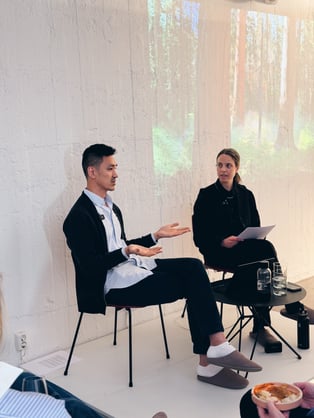
The problem with learning alone
Most leadership programs are built around content. Frameworks to absorb, models to apply, concepts to carry back to the workplace. The assumption is that the right knowledge will eventually produce the right behavior.
It rarely does.
Filip has watched this play out enough times to recognize the pattern. A vendor arrives, customizes their existing material, and delivers something that looks bespoke but is optimized for what vendors have always been paid to produce: content. The real challenges leaders face, though, aren't knowledge problems. They're behavioral ones.
The broken telephone game
When a CEO sets a bold direction, something predictable happens. The message is sharp at the top. By the time it reaches mid-level managers running operations across dozens of markets, it's barely recognizable.
That's the gap Filip argues L&D should be designed to close. Not a skills gap, a translation gap, between strategic intent and everyday decision-making at every level of the organization. Most programs don't go near it. They build capability in the abstract, then return people to the same environment and hope something shifts.
What learning with peers actually looks like
A program designed for behavioral change is structurally different from a traditional one. Sessions are built around real problems, worked through together. No slides. No frameworks delivered from the front. Leaders practice translating strategy into action alongside peers navigating the same pressures. Facilitators guide rather than instruct.
And the design has to hold up under real conditions, a first-week manager and a thirty-year veteran going through the same experience and both finding it relevant. If it only works under ideal circumstances, it won't survive contact with an actual organization.
Why shared practice beats shared content
Access to content has never been easier. Frameworks, models, and leadership theory are available to anyone. AI has accelerated this further. Inside large organizations, decentralized teams are already generating their own materials, adding more to the pile changes little.
Filip's answer is to skip the content and go straight to the behavior. Define what you actually need leaders to do differently. Build everything around practicing that, together. Then measure whether it changes.
You can't solve a behavioral problem with more information. But when leaders work through real challenges alongside peers, the right behaviors stop being aspirational, they become habitual.
The thread running through all of it
.jpg?width=360&height=480&name=IMG_1043%20(1).jpg) Three conversations. Three organizations. Three very different contexts. But the same underlying shift: L&D is moving from content delivery to something more intentional and more strategic.
Three conversations. Three organizations. Three very different contexts. But the same underlying shift: L&D is moving from content delivery to something more intentional and more strategic.
- Hedvig's work points to the team as the core unit of learning, the place where skills become habits and culture becomes real.
- Katarina's work points to communities as the infrastructure for knowledge to move beyond what any centralized function could build alone.
- Filip's work points to behavior as the only meaningful measure of success, and to the idea that if you design the right environment, you can skip the content entirely and go straight to the change that actually matters.
That last point deserves to sit with us. L&D is very good at helping others navigate change. But the same scrutiny we apply to others needs to be applied to ourselves. The models, the processes, the assumptions about how learning gets built and delivered: all of it is up for question.
These shifts aren't easy. They require:
- Going deeper into the business than most L&D functions are used to
- Getting comfortable with not having all the answers upfront
- Measuring success by standards that are harder to hit but far more meaningful
- Being willing to let go of approaches that have worked well but may no longer be enough
.jpg?width=224&height=299&name=7B518900-CD64-48D6-82F1-3A3A07A66A54%20(1).jpg) But they also represent something genuinely exciting: a version of L&D that is less about managing a catalogue and more about how an organization thinks, learns and grows together.
But they also represent something genuinely exciting: a version of L&D that is less about managing a catalogue and more about how an organization thinks, learns and grows together.
The evening ended with breakout groups: small tables of senior L&D leaders in lively, honest, sometimes uncomfortable conversation. That energy felt like a signal. The conversations L&D needs to be having, about strategy, about behavior, about what our function is actually for, are not happening enough. Not at this level of honesty and not with this kind of peer-to-peer depth.
Maybe the most important thing L&D can do right now is create more spaces like thit. For our organizations, our teams, and for ourselves.
Summary edited by Emilia Åström, Community Lead, L&D Leaders. L&D Leaders Salon is an invitation-only gathering for senior internal L&D and organisational development leaders.

-1.png)